
When fitting out an office, flooring is often specified last. It shouldn't be. Material choice affects indoor air quality through VOC emissions, acoustic conditions through sound absorption, and the visual character of the space. Eco-label certified carpet tiles address all three — the certification provides independent, government-backed verification that the product meets Korea's environmental standards for indoor materials.
In this guide, we walk through everything decision-makers need to know about choosing eco-friendly carpet tiles for office environments — from what eco-label certification actually means, to how Anker carpet tiles earned Korea's official Eco-Label (Certification No. 제34864호), to how TORNEX delivers tailored solutions from acoustic-based specification to precision installation for any project, at any scale.
Why Flooring Defines Your Office Environment
Flooring is the single largest horizontal surface in an office interior. Every chair movement, footfall, and walking path happens at floor level — which means the material directly affects indoor air quality through VOC emissions, acoustic conditions through sound absorption, and the visual character of the space.
Conventional flooring — vinyl tile, laminate, bare concrete — is typically selected on cost and durability. Flooring specified with acoustic and emission performance in mind produces measurably different results: lower ambient noise levels, better indoor air quality, and longer replacement intervals.
The key performance indicators for office flooring are: (1) indoor air quality — VOC and formaldehyde emissions, (2) acoustic performance — impact noise reduction and sound absorption, (3) durability and maintenance cost, and (4) design flexibility. Eco-label certified carpet tiles score well across all four dimensions, and the certification provides independent, third-party verification that the product delivers on its environmental claims.
The Korean Eco-Label Certification: What It Actually Means
Korea's Environmental Label (환경표지) is an official certification issued by the Korea Environmental Industry and Technology Institute (KEITI) under the Ministry of Environment. Products bearing this mark have undergone rigorous third-party testing across their full lifecycle — from raw material sourcing and manufacturing through in-use performance and end-of-life recyclability.
For carpet tiles, the certification requirements are particularly demanding. Tested parameters include total volatile organic compounds (TVOC), formaldehyde emissions, heavy metal content, and manufacturing effluent standards. Products must meet threshold limits across all categories — a single category failure disqualifies the entire product line.
Korea Eco-Label Key Testing Parameters — Carpet Tiles
- TVOC: ≤ 0.4 mg/m²·h
- Formaldehyde: ≤ 0.015 mg/m²·h
- Heavy metals (Pb, Cd, Cr, Hg): Not detected
- Recyclability assessment: Required
The eco-label mark carries weight with corporate procurement teams, ESG reporting requirements, and building certification systems (G-SEED, LEED). Specifying certified products is increasingly a compliance matter, not merely a preference. In 2024, multiple large Korean enterprises updated their procurement guidelines to require eco-label compliance for interior materials — a trend that is accelerating across all sectors.
Critically, the eco-label is not a self-certified marketing claim. It requires independent laboratory testing, on-site factory audits, and annual renewal. Products can lose certification if manufacturing standards slip. When you specify an eco-label product, you are specifying a material whose environmental performance is continuously monitored by a government-backed body.
Why Carpet Tiles Lead Office Flooring Specifications
Carpet tiles have become the standard specification for office flooring across commercial interiors globally — and the reasons extend well beyond aesthetics.
Acoustic Performance
Carpet tiles absorb impact noise from footfall, reduce reverberation, and diminish the transmission of ambient office noise. In open-plan offices, this translates directly into measurable reductions in distraction and fatigue.
Modular Replaceability
Individual tiles can be replaced when stained or worn, without full-floor re-specification. This eliminates wasteful large-scale replacements and dramatically reduces lifecycle cost.
Design Flexibility
Collections span hundreds of colors, textures, and patterns. Mixed-tile zoning — using different colors to delineate focus areas, collaboration zones, and circulation paths — is a design strategy that only carpet tiles enable efficiently.
Indoor Air Quality
Certified carpet tiles act as a passive particulate filter, trapping airborne dust and allergens at floor level where they are less likely to be re-suspended into the breathing zone.
Carpet tiles are also fully compatible with raised-floor access systems — a standard requirement in technology-intensive environments. Under-floor cabling can be accessed without disrupting large surface areas. This operational flexibility is a significant factor in total cost of ownership for any office with substantial IT infrastructure.
However, not all carpet tiles deliver these benefits equally. Eco-label certification is the differentiator — it guarantees that the environmental performance claims are independently verified, not self-declared. Among certified options, the competence of your installation partner determines whether the specification intent is realized precisely on site.
Planning an office flooring project? Let TORNEX specialists help you select the right specification for your space — at no charge.
Request a Consultation →Anker Carpet Tiles: Korea Eco-Label Certified (No. 제34864호)
Anker has been manufacturing carpet tiles in Germany for over 170 years. The brand's longevity reflects consistent product quality and manufacturing standards across successive generations of commercial interior projects.
In Korea, Anker carpet tiles are now certified under Korea's official Eco-Label program (Certification Number: 제34864호). This certification was awarded following independent laboratory analysis across all KEITI-mandated parameters. The results demonstrate performance that far exceeds the minimum requirements.
Eco-Label Test Results — Anker Carpet Tiles (Certification No. 제34864호)
- TVOC: 0.02 mg/m²·h — 95% below the permitted limit of 0.4
- Formaldehyde: 0.006 mg/m²·h — 60% below the permitted limit of 0.015
- Toluene: Not detected
- Heavy metals (Pb, Cd, Cr, Hg): Not detected
TVOC at 0.02 against a permitted limit of 0.4, formaldehyde at 0.006 against 0.015 — both well within threshold. These figures reflect Anker's standard manufacturing quality rather than a product formulated specifically for certification compliance.
Anker's 16 carpet tile collections cover the full range of commercial interior applications. Representative collections include: PALETTE and QUARTZ for corporate open-plan and executive floors, BLOCK and MIST for contemporary workspace design, and the FluidStop hygiene series for healthcare facilities and food-service environments where elevated sanitation standards apply. Each collection is available in multiple colorways, and every collection carries the eco-label certification.
Key Specifications
| Specification | Details |
|---|---|
| Pile Construction | Loop Pile / Cut Pile / Combination |
| Tile Size | 500 × 500 mm / 457 × 914 mm |
| Thickness | 6.5 mm |
| Backing | Unit Back / Unit Back Pro |
| Collections | 16 (all eco-label certified) |
| Certification | Korea Eco-Label No. 제34864호 |
TORNEX Tailored Solutions: From Specification to Installation
As the official TORNEX dealer for Anker carpet tiles, we go beyond product supply. Our value is delivered in three stages that transform a specification into a realized installation:
1. Acoustic-Based Specification
We evaluate your space's acoustic requirements — reverberation targets, impact noise thresholds, occupancy patterns — and match the right Anker collection and backing to your specification. No guesswork: specification grounded in acoustic data.
2. Layout Design & Zoning
We design the tile layout for your floor plan — including multi-zone color strategies, curved partition transitions, and mixed-colorway patterns. Precision cutting capability ensures design intent is followed to the centimeter, not approximated to the nearest grid line.
3. Installation & Project Management
TORNEX manages the full installation — site preparation, subfloor assessment, tile laying, and post-installation inspection. For large-scale projects, we coordinate phased installation to minimize disruption to ongoing operations.
The following completed projects demonstrate this three-stage approach in practice.
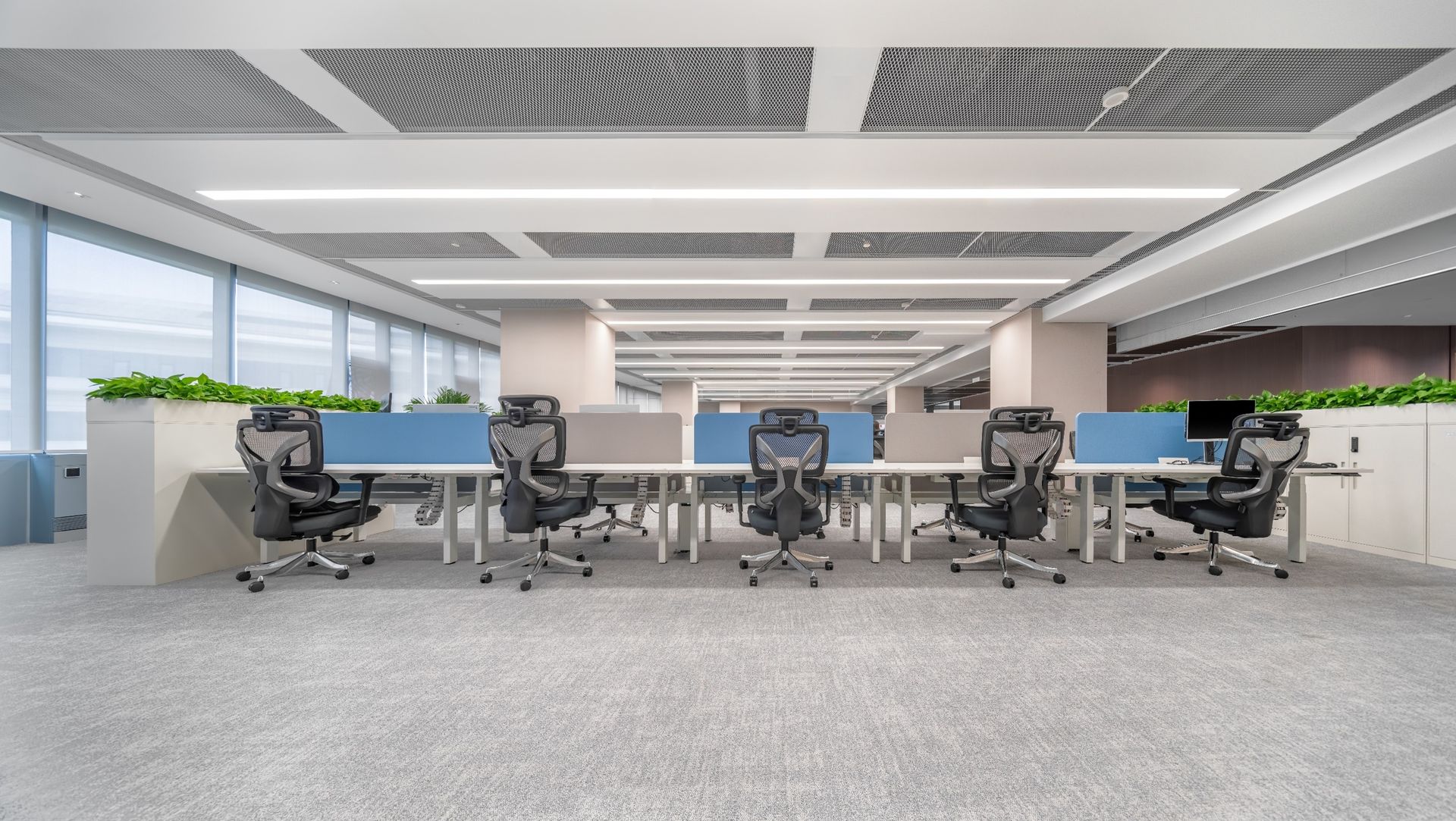
At a major corporate headquarters renovation in Seoul, the specification team selected Anker carpet tiles for the full open-plan floor plates — approximately 8,000m² across multiple floors. The selection was driven by acoustic requirements, aesthetic continuity across department zones, and the project team's ESG materials reporting obligation. Anker's eco-label certification provided the documentation required for the project's sustainability disclosure. Post-installation measurements confirmed impact noise reduction consistent with the product specification.

In a professional services office refurbishment, the design team specified Anker's two-tone tile zoning strategy — a warmer colorway in collaboration areas, a cooler neutral in focused-work zones. TORNEX's precision cutting allowed transition cuts at zone boundaries to follow the curved partition layout exactly, rather than forcing a grid-aligned cut that would compromise the design intent. The resulting installation reads as a single cohesive design.
These project examples reflect a consistent pattern: environments where acoustic performance, indoor air quality, design precision, and long-term maintainability are all required simultaneously. Eco-label certified carpet tiles, specified and installed with technical competence, deliver reliably across all four dimensions — regardless of building type, industry, or project scale.
Ready to specify Anker eco-label carpet tiles for your project?
Consult with TORNEX specialists — acoustic evaluation, layout design, and full installation support included.