
Your office looks modern—open plan, glass partitions, sleek furniture. But every time someone takes a phone call or the team next door starts brainstorming, concentration shatters. The culprit isn't the people; it's the acoustics. Hard surfaces like concrete, glass, and wood reflect sound waves, creating a noisy echo chamber. The solution? Sound-absorbing materials—but which type is right for your space?
In this guide, we compare the three most popular acoustic materials used in commercial interiors today: PET (recycled polyester), melamine foam, and wood wool. We'll break down their performance, aesthetics, safety, and best-fit applications so you can make an informed decision.
Why Sound Absorption Matters in the Office
Sound travels in waves. When those waves hit a hard surface, they bounce back—creating reverberation. In a typical office with concrete ceilings and glass walls, reverberation time (RT60) can exceed 1.0 seconds, far above the recommended 0.5–0.6 seconds for speech intelligibility.
The result? Overlapping conversations, reduced speech privacy, and measurable drops in productivity. Studies show that office noise is the #1 complaint among knowledge workers—ahead of temperature, lighting, or air quality.
Key Metric: NRC (Noise Reduction Coefficient)
NRC ranges from 0 (total reflection) to 1 (total absorption). For office environments, materials with NRC ≥ 0.7 are recommended for walls and ceilings.
PET Acoustic Panels — The Modern All-Rounder
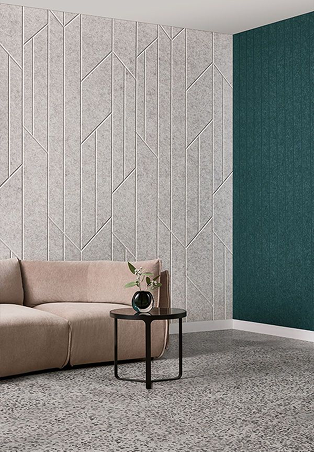
Made from recycled PET plastic bottles, PET acoustic panels have become the go-to choice for modern commercial interiors. They combine excellent acoustic performance with sustainability and design flexibility.
Performance Specs
• NRC: 0.79 (9mm) / 0.84 (12mm) / 0.90 (24mm) — KCL certified
• Fire rating: FITI flame-retardant certified (9/12/24mm each)
• Eco certifications: OEKO-TEX Standard 100, Global GreenTag Platinum
Design Versatility: PET panels come in an extraordinary range of forms—wall panels (basic, V-design, 3D, printed, wavy), ceiling baffles (linear, ripple, curve, arc, wing), ceiling clouds (circle, hexagon, square), and standing objects (desk screens, acoustic cubes). With 107 colorways, architects can match any interior palette.
Best For: Open offices, co-working spaces, lobbies, meeting rooms—anywhere that needs high absorption with a premium aesthetic.
Melamine Foam — Broadband Absorption
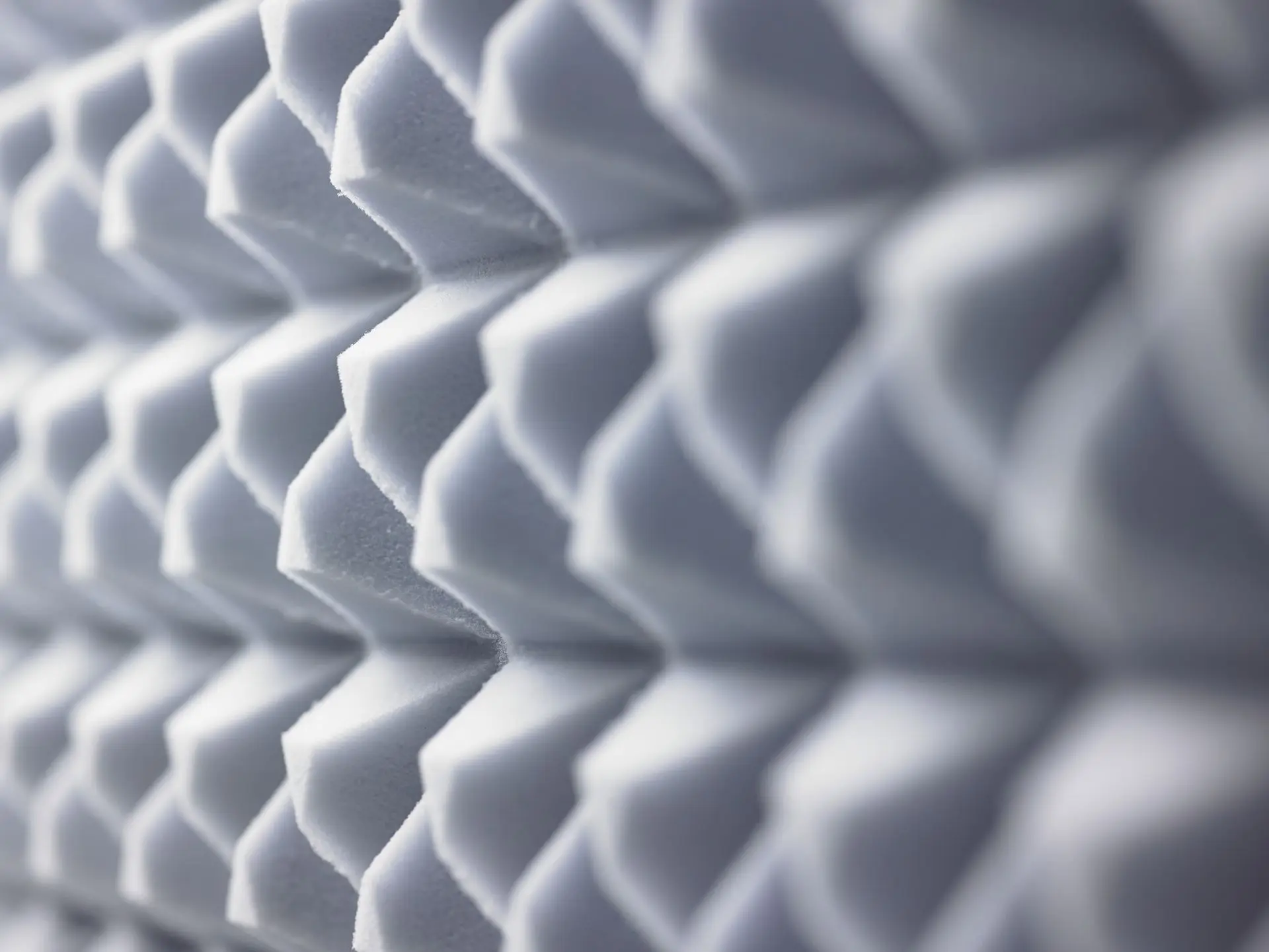
Melamine foam is an open-cell foam with an extremely fine internal structure. This gives it very high NRC values—often exceeding NRC 0.95 at 50mm.
Performance Specs
• NRC: 0.95+ (50mm) — outstanding broadband absorption
• Fire rating: Flame-retardant certified (self-extinguishing)
• Temperature resistance: -200°C to +200°C
Industrial Strength: Originally developed for extreme environments—aircraft engines, HVAC systems, server rooms—melamine foam brings industrial-grade performance to architectural applications. It excels in spaces where fire safety is critical, such as hospitals, data centers, and high-rise buildings. Recently, with diverse fabrication and painting options, it has also been applied to sophisticated interior spaces.
Modern Applications: With advances in custom finishing and painting, melamine foam is now also featured in high-end interior projects—far beyond its industrial roots.
International Fire Certifications: VIXUM melamine foam holds 9 international fire and flame-retardant certifications — including Korea KFI (flame retardancy), KCL UL94 V-0, Europe EN 13501-1, Germany DIN 4102-1, and USA ASTM E84. Based on VIXUM-certified raw material, finished by TORNEX, it is approved for use in architectural, railway, and industrial applications worldwide.
Wood Wool Boards — Natural Aesthetics, Proven Performance
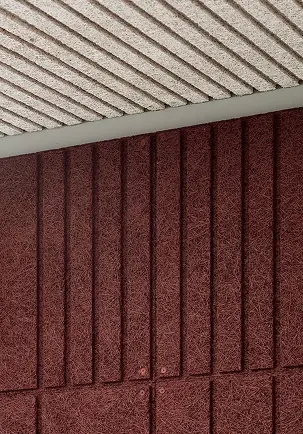
Wood wool (also called "cement-bonded wood fiber") boards have been used in European architecture for over a century. Thin strands of wood are bonded with cement to create a rigid, textured panel with natural acoustic absorption.
Performance Specs
• NRC: 0.60–0.85 (depending on thickness and mounting)
• Fire rating: A2-s1,d0 (non-combustible class)
• Sustainability: Natural wood fiber + mineral binder, fully recyclable
Design Character: Wood wool boards deliver a distinctive organic texture that is impossible to replicate with synthetic materials. Available in natural wood tones and custom paint finishes, they bring warmth and a biophilic design element to modern interiors.
Best For: Lobbies, restaurants, cafés, retail spaces, cultural venues—anywhere that benefits from a natural, textured aesthetic.
Head-to-Head Comparison
| Criteria | PET Panel | Melamine Foam | Wood Wool |
|---|---|---|---|
| NRC (typical) | 0.79–0.90 | 0.90–0.95+ | 0.60–0.85 |
| Fire Safety | Flame-retardant | Self-extinguishing | Non-combustible (A2) |
| Eco Credentials | Recycled PET | Synthetic | Natural wood fiber |
| Color Options | 107 colors | Base: White/Gray (Any Color when painted) | Base: Natural (Any Color when painted) |
| Form Factor | Wall/Ceiling/Standing | Wall/Ceiling | Wall/Ceiling |
| Moisture Resistance | Good | Excellent | Excellent |
| Custom CNC Cutting | Yes | Yes | Yes (outsourced) |
How to Choose the Right Material
Choosing the right acoustic material isn't just about NRC numbers. Consider these decision factors:
Step 1: Define the Problem
Is the issue general reverberation, speech privacy, or impact noise? Reverberation → wall/ceiling panels. Speech privacy → absorption must come first, then consider sound masking (masking alone without absorption can backfire). Impact noise → floor treatment (carpet tiles).
Step 2: Check Building Codes
Korean fire codes require flame-retardant certification for interior finishes above certain heights. PET panels with FITI certification and melamine foam both meet this requirement. Verify with your local fire marshal.
Step 3: Match to Design Intent
Modern minimalist → PET (clean lines, vast color palette). Industrial chic → Melamine (raw texture). Biophilic/organic → Wood wool (natural warmth). The material is part of the design language.
Step 4: Consult an Expert
Every space is different. A 3D acoustic simulation can predict exactly how much absorption you need and where to place it—before a single panel is installed. This prevents both under-treatment (still noisy) and over-treatment (sounds dead).
Conclusion
There is no single "best" acoustic material. The right choice depends on your space, your design vision, and your performance requirements. PET panels offer the most versatile solution for typical offices. Melamine foam delivers maximum absorption for demanding environments. Wood wool boards add natural character that no synthetic material can replicate.
The most effective acoustic designs often combine multiple materials—PET baffles on the ceiling, melamine panels behind equipment, and carpet tiles on the floor—to address different frequency ranges and use zones.
Interested in the products discussed in this article?
View Product → PET Acoustic Panels View Product → Melamine Foam View Product → Wood Wool Boards