
When meeting with the corporate general affairs team or facility managers, there is a common complaint I hear.
"We spent a lot of money remodeling into an open office for collaboration, but employees are instead using earphones and communicating via messenger."
The expectation that visual openness will lead to increased communication is collapsing in the field. The sounds of phone calls, keyboard typing, and casual conversations from nearby are increasing cognitive load and distracting employees' focus. This is not just a simple inconvenience; it is an invisible cost that erodes corporate productivity. Tornex addresses this issue not through intuition or sensation, but through thorough data and international standards.
The problem is not the sound, but the clarity.
An office does not have to be completely quiet to be good. If it is too quiet, even small sounds can be amplified, infringing on privacy. The key is to create an optimal acoustic environment wheresounds are heard but the content is not understood.Technical significance
KS F ISO 3382-3, the Korean standard for office acoustics, provides objective metrics that quantify how far conversational speech travels and how clearly it is perceived in open-plan offices.
The table below summarizes how the key parameters defined in ISO 3382-3 are directly linked to real-world business performance outcomes.
Metric | Technical meaning | Business goals and expected effects |
|---|---|---|
STI | A value between 0.0 (hearing impairment) and 1.0 (perfect understanding). | When managing the STI value below 0.5,it becomes difficult to understand conversations between adjacent departments, significantly reducing work disruptions.The distance at which conversation clarity begins to decline. |
D2S | The shorter, the better. | By shortening this distance, the radius of noise damage decreases, allowing for more efficient placement of personnel within the same area. |
Lp,A,S,4m | The average conversation sound level at a distance of 4m from the speaker. | The lower, the better. When the standard recommendations are achieved, overall office noise fatigue decreases, and research shows that employee concentration improves by an average of over 15%. |
Note: The above figures are examples based on general research results and Tornex's own simulation data, and may vary depending on actual site conditions.
Tornex does not simply suggest adding a lot of sound-absorbing materials. We apply a systematic process from the architectural design stage or for spaces already in operation.
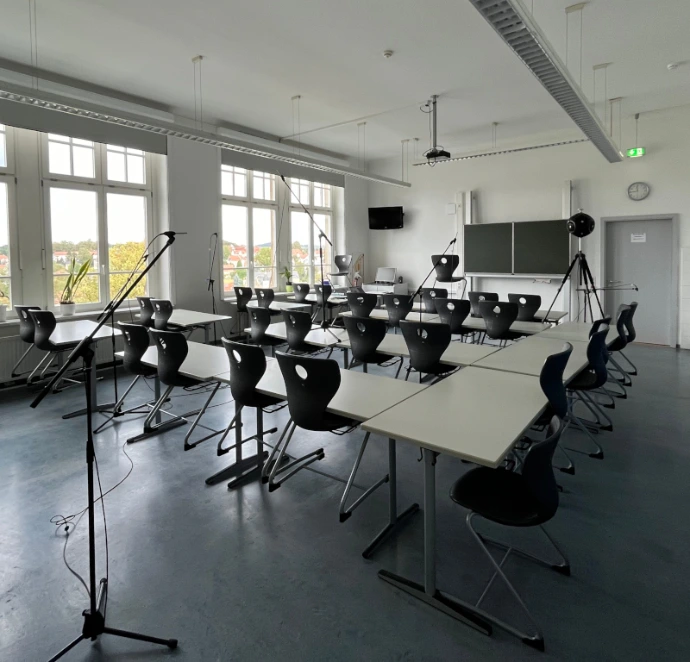
3D Simulation
According to ISO 3382-3, key acoustic parameters of the space—such as STI and D2S—are measured using an omnidirectional loudspeaker and microphones.
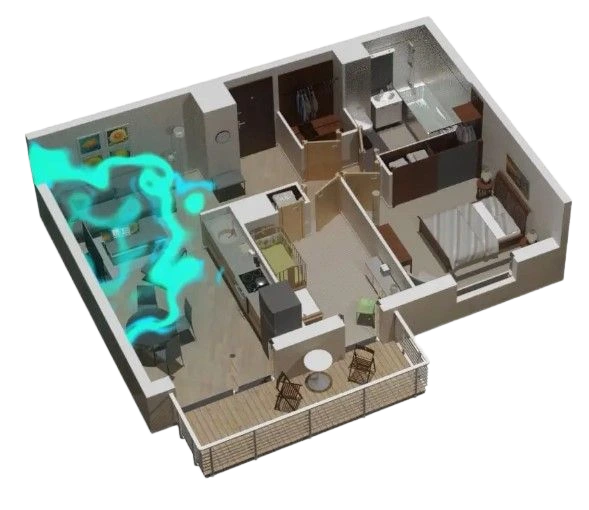
Using specialized software like the innovative Treble, we predict how the acoustic environment will change with furniture layout or finishing material changes.
Deriving optimal solutions
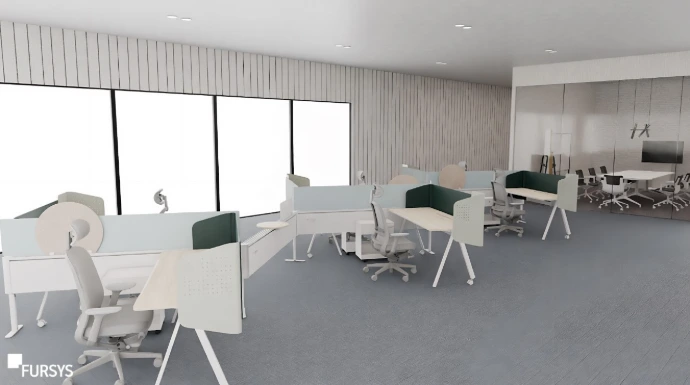
Based on simulation results, we strategically place high-performance sound-absorbing solutions and sound masking systems at the most cost-effective points (ceiling, partitions, walls).
The conclusion is clear. The success of open offices depends not on visible design, but on the audible acoustic environment.
Is your office a productive space or a test of patience? Experience comfort that is proven by data.
For those who want to find out if their office needs improvement with a simple test.Simple diagnostic guideI hope this helps.